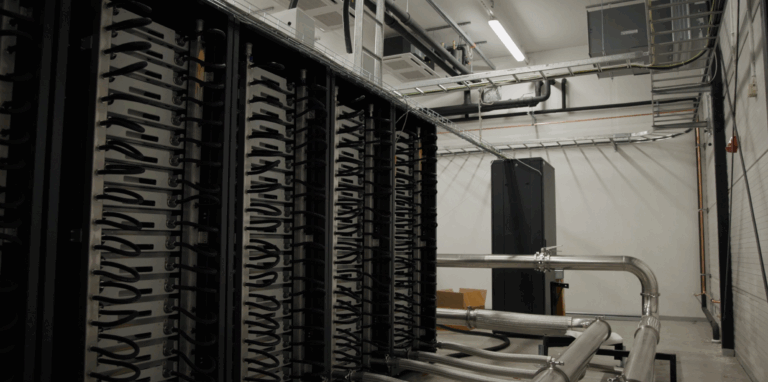
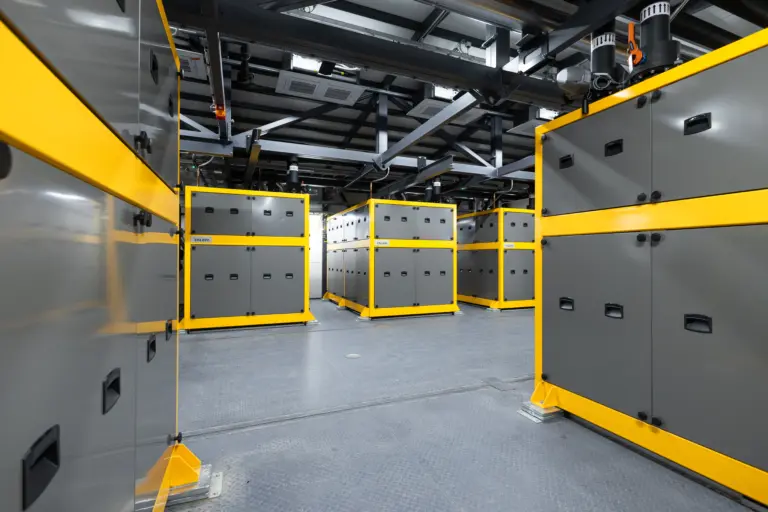
Savon Voima, a Finnish energy company, has now operated its innovative AmbiHeat heat pump plant in Joensuu, Finland, for nearly a full year. The first year of operation has shown that the solution, built around two heat sources, performs as expected and supports Savon Voima’s goal of electrifying its heat production. In July, the plant produced heat without combustion for more than a month.
A year ago, Kari Anttonen, Business Director at Savon Voima, and Mikko Heikkilä, Member of Calefa’s Board of Directors, received the Heat Pump City of the Year 2025 award in Brussels for the innovative AmbiHeat heat pump plant in Joensuu.
The award was granted by the European Heat Pump Association (EHPA) to a solution that was the first of its kind in Europe: a single heat pump plant utilising both flue gas scrubber condensate heat from a power plant and river water as heat sources.
At the time, the plant had only recently been completed. Now, with nearly a full year of operation behind it, practical experience has confirmed that the solution performs reliably under all operating conditions.
“Overall, we consider the project a success from design and implementation all the way through to operation,” says Veli-Matti Keronen, Operations Manager at Savon Voima.
Summer Operation Confirmed the Effectiveness of River Water Utilisation
In March 2026, when the plant had accumulated approximately 300 operating hours, it had already demonstrated its ability to recover waste and condensate heat from the flue gas scrubber.
Of At that point, summer operation using river water had not yet been tested.
In autumn of 2026, Veli-Matti Keronen says the plant has fully met Savon Voima’s expectations and performed during the summer exactly as planned.
“Around July, we were able to produce heat for more than a month without any combustion-based heat production,” he says.
The plant’s availability also met all targets.
“The automation works well, and the overall system has proven highly reliable.”
According to Jukka Varonen, Project Manager at Savon Voima, the plant has also been easy to operate.
“It starts up easily, delivers a stable heat output, and does not require continuous supervision in the same way as a traditional solid-fuel plant,” Varonen adds.
Veli-Matti Keronen also highlights the smooth cooperation between the companies. Support has been readily available whenever needed, and collaboration has continued seamlessly after commissioning.
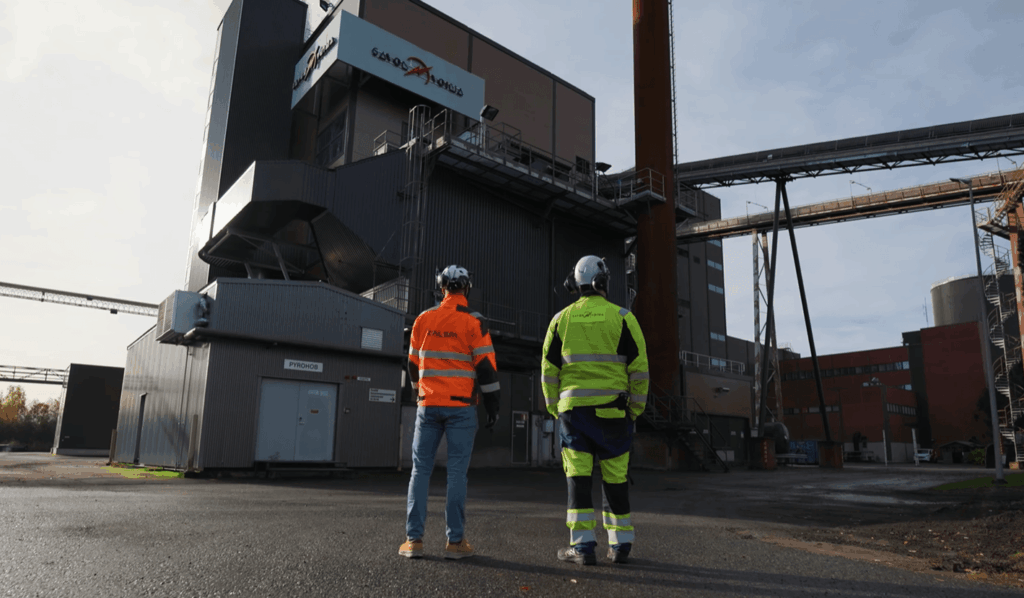
Savon Voima Is Building the Future of Heat Production
The AmbiHeat plant in Joensuu is part of Savon Voima’s long-term efforts to electrify heat production and reduce reliance on combustion-based energy generation. The project supports the company’s goal of producing carbon-neutral district heating by 2030.
During the winter season, the heat pump plant utilises condensate heat from the flue gas scrubber and delivers approximately 6 MW of additional heating capacity to Joensuu’s district heating network. In summer, river water serves as the heat source, providing approximately 4–5 MW of heating capacity.
The same plant can utilise multiple heat sources throughout the year, making the solution unique.
“This solution increased the annual operating hours of the heat pumps. With multiple heat sources available, the same equipment can be utilised more extensively,” Keronen explains.
A World-Class Solution Built Through Finnish Energy Collaboration
The AmbiHeat plant in Joensuu remains exceptional even on a European scale. It is the first project of its size in Europe where a single heat pump plant utilises two separate heat sources.
Another distinctive feature is its ability to produce heat from very low-temperature heat sources.
“No one has heated the river water. The energy comes from nature and the sun, and now we are making use of it. The technology has advanced to the point where water that is below 20°C can be used to produce district heating water at temperatures of up to 72°C,” says Jukka Varonen.
Varonen views the project as somewhat different from many other energy projects.
“The modular heat pump plant was built within decommissioned facilities, and the result has been integrated into the environment so naturally that it looks as if it has always been part of the power plant.”
For Petri Vuori, CCO of Calefa, the project demonstrates how customer objectives and new-generation heat pump technology can be combined into an effective overall solution.
“Savon Voima has systematically electrified its heat production. It has been great to participate in delivering solutions that support the reduction of combustion-based energy production,” Vuori says.
According to Veli-Matti Keronen, one of the key strengths of the overall solution is that electric heat production can be combined with thermal energy storage and existing production methods.
“This is an interesting example for others who are considering similar solutions,” Keronen says.