The structural transformation underway in Northern Europe’s energy sector is accelerating the shift toward electrified heat production. The rapid growth of wind power has brought large amounts of affordable and variable electricity to the market, making market-driven heat production more profitable than before.
Energy companies and municipalities are now looking for solutions that can produce heat cost‑effectively while responding quickly to price fluctuations.

Producing Heat at the Right Time, at the Right Price
The fast controllability enabled by electric boilers is well suited to situations where electricity prices are especially low or when there is a sudden need to increase output.
“Wind power capacity has multiplied over the past five years. It brings a lot of affordable but variable power to the market, and production must be able to react quickly to that”, says Petri Vuori, CEO of Calefa Oy.
When output can be ramped up instantly, heat can be produced when market prices are at their lowest. In addition, heat can be stored in a thermal energy storage unit for later use. Thermal storage also helps balance production in situations where the network cannot absorb large amounts of thermal energy at once.
This flexibility is crucial not only for cost efficiency but also for maintaining the balance of the electricity system. Fast‑responding solutions enable participation in reserve and balancing markets, which require precise and rapid control of production.
Heat Pumps Form an Energy‑Efficient Foundation for Energy Production
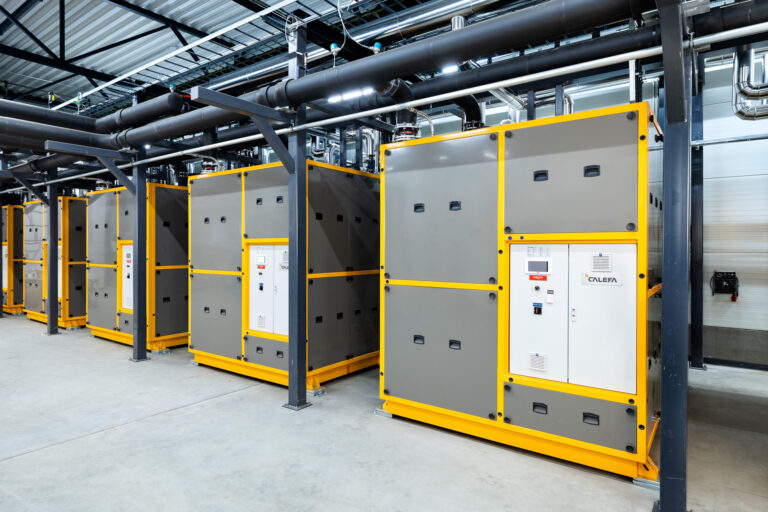
Heat pumps, such as in AmbiHeat plants, are an excellent solution for covering the base load of heat production. Their high efficiency makes it possible to produce heat cost‑effectively even when electricity prices are not at their lowest.
According to Petri Vuori, heat pumps and electric boilers should not be seen as mutually exclusive alternatives. Instead, each plays a distinct role in a well‑functioning energy system.
“Electric boilers enable rapid response to reserve market requests and make use of cheap electricity, while heat pumps handle base load with a coefficient of performance three to five times higher,” he summarizes.
With heat pumps, a significant share of a district heating network’s annual heat demand can be covered. Their operation can also be controlled based on electricity prices, if desired.
The role of thermal energy storage is to ensure that heat produced during low‑price hours is not wasted. Both heat pumps and electric boilers often generate more heat during cheap electricity hours than the district heating network can immediately absorb.
In such cases, thermal storage acts as a balancing element, allowing production to be sized according to market conditions without losses or output limitations.
Modular and Scalable Solutions Secure the Future of the Investment
Both in Finland and globally, heat production is increasingly characterized by a growing need for flexibility—now and in the future. Heat production requirements can change rapidly, and systems must be able to adapt accordingly.
When electric boilers, heat pumps, and thermal energy storages are designed from the outset as an integrated system, capacity can be expanded step by step without major structural changes. This makes investments more predictable and ensures that the solution adapts to changes in market conditions as well as customer needs.
“Modular solutions make future heat production easier to plan. Electric boilers, heat pumps, and thermal energy storage can be integrated into a single system where each component has its own role, and new modules can be easily added later,” Vuori explains.
Modularity provides investment security. Capacity can be added as demand grows or as market conditions evolve. Such flexibility is particularly important in an energy market that is in constant transition.
Toward More Flexible and Cleaner Energy Production
Electrified heat production has already become a key part of the energy system, and its role is expected to continue to grow in the future. As energy markets evolve, an increasing share of production is based on variable renewable electricity. This highlights the need for solutions that can respond quickly to changes in both electricity prices and demand.
Electrified heat production makes it possible to take advantage of a changing energy system. It enables clean and cost‑efficient production during favorable market hours while reducing dependence on traditional, less flexible production methods.
When electric boilers, heat pumps, and thermal energy storage are combined into an integrated system that leverages advanced automation, production can be precisely aligned with both demand and electricity market conditions.
“Heat demand is often variable and does not necessarily follow the same cycle as cheap electricity hours. That is why electrified heat production should be implemented with versatility and adaptability as guiding principles,” Petri Vuori concludes.
Looking for a Solution for Electrified Heat Production?
Explore the modular AmbiHeat concept and ask our experts for more information.

Petri Vuori
CEO
+358 40 553 4427
petri.vuori@calefa.fi