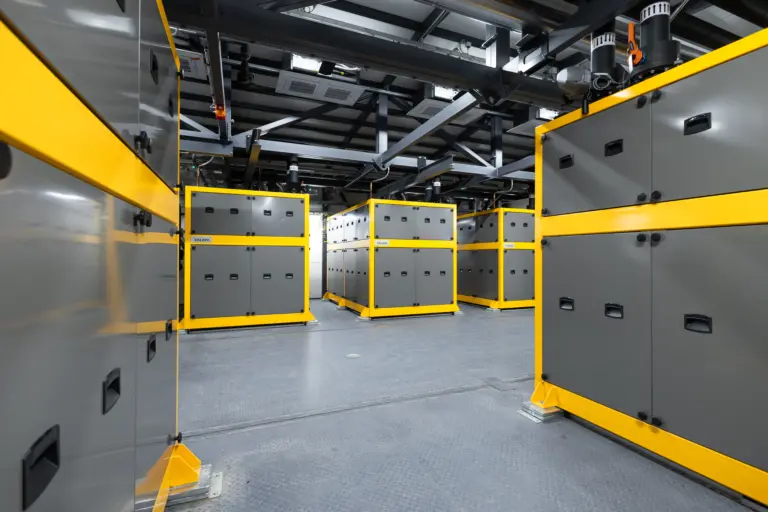
In a biogas plant, the demand for heating and cooling typically stems from maintaining reactor temperature, hygienisation, and gas treatment. The modular AmbiHeat solution delivers reliable cooling and simultaneously reduces the need to produce heat using biogas.
When improving the energy and material efficiency of biogas plants, a key question is how to link waste-heat streams, cooling demand and heating needs so the process remains stable across all operating conditions.
From a heating perspective, the goal is to avoid using produced biogas to heat the plant or maintain reactor temperature. Therefore, as large a share of the output as possible can be sold onward.
When it comes to cooling, reliability is essential. Gas treatment, drying and hygienisation require consistent, uninterrupted cooling. From an energy-efficiency standpoint, the decisive factor is whether the waste heat generated in cooling can be recovered and reused as part of the plant’s heating system.
Industrial heat pumps for recovering waste heat in biogas plants
Industrial heat pumps provide an efficient way to utilise low-temperature sources,such as waste heat from cooling.
With Calefa’s award-winning heat pump technology, heat can be upgraded even from low temperatures (approximately 10–20°C) for use, for example, in the plant’s heating network or for maintaining reactor temperature (typically up to 90–100°C).
However, starting points are not the same at every site. For example, cooling requirements and available heat streams vary depending on the process type.
“In the AmbiHeat solution, an electric boiler can be added alongside the heat pumps, ensuring heat production even when waste heat is not available for one reason or another,” says Heinonen.
If needed, the heat pumps can even upgrade heat from outdoor air, which broadens the solution’s applicability across different deliveries. Learn more about the AmbiHeat solution here.
Reliable heating and cooling
In a biogas process, especially in gas treatment, cooling plays a key role alongside heating. An advantage of the AmbiHeat solution is that both heating and cooling can be delivered as a single integrated system.
For example, the cooling required for biogas drying can be implemented in an energy-efficient way so that the resulting waste heat is directly recovered and reused.
“At the same time, the waste heat generated in cooling can be upgraded directly into the plant’s heating network,” Heinonen notes.
As a result, energy released from cooling is not wasted, improving not only the energy balance but also the predictability of operations.
Calefa’s AmbiHeat solution in a biogas plant
- Lower biogas consumption: When process heat is produced through electrified solutions and by utilising waste heat, a larger share of the produced biogas can be allocated for sale.
- Both heating and cooling: Cooling in gas treatment generates heat that can be recovered and upgraded to the required process temperature level.
- Temperature level matching: AmbiHeat is a natural fit when the heat source is low-temperature, but the process heat sink requires a clearly higher level (e.g., pasteurisation/hygienisation, process water, buildings/district heating).
- More stable operations: when heat flows can be controlled and temperature levels stay on target, the risk of disturbances in the biological process is reduced.
- Modular hybrid concept: AmbiHeat can be delivered as a complete system where the heat pump covers the base load and, for example, an electric boiler supports start-ups and peak demand.
- Reliability and lifecycle support: Calefa combines AmbiHeat deliveries with the CalefaCare service (monitoring, maintenance, optimisation).
Energy efficiency also supports the overall business
When waste heat is recovered and upgraded to a usable level, the biogas plant’s energy balance is stabilized. This reduces the need for purchased energy or heat produced from the plant’s own biogas.
At the same time, more biogas can be directed to sales, and heat production can be handled with electrified solutions where it makes the most total-economic sense.
The AmbiHeat system is often built with a hybrid approach. In all operating modes, waste heat is not always available. For example, after a production shutdown, heat is needed to start the process before energy can be recovered from cooling in the circulation loops.
“In that case, the heat pump can use outdoor air as a second energy source, or the system can be combined with an electric boiler—and, if needed, also a biogas boiler. This way, the base load can be produced efficiently with the heat pump, while ensuring the process can be brought up in a controlled manner and that heat is available even in exceptional situations,” Heinonen says.
Reliability and lifecycle management are decisive
In biogas production, an energy solution is not assessed solely through efficiency, but reliability is also crucial. If heat production or cooling is uncertain, the consequences can ripple through the entire production, and in biological processes recovery can take time.
For this reason, Calefa places particular emphasis on solution reliability and lifecycle support. The CalefaCare service ensures help is available quickly in any situation, even years after commissioning.
“No technology runs for years on its own. At Calefa, we aim to minimise production-disrupting surprises and ensure process temperatures remain under control in all operating conditions,” Heinonen says.
Towards carbon-negative biogas
Biogas is a carbon-neutral, and even potentially carbon-negative, energy source with a key role in the energy transition. Improving the energy efficiency of its production directly supports this development.
When the energy balance is brought into equilibrium, biogas can be utilised to its full potential as part of a sustainable and flexible energy system.
Ask our experts for more information about Calefa’s solutions for biogas plants:

Lari Heinonen
Sales Manager
+358 40 5238591
lari.heinonen@calefa.fi

Petri Lång
Sales Manager
+358 50 380 5378
petri.lang@calefa.fi