The world’s cleanest aluminum profiles are produced in Finland. Calefa is one of the long-term partners supporting the family-owned manufacturer Mäkelä Alu on its sustainability journey.
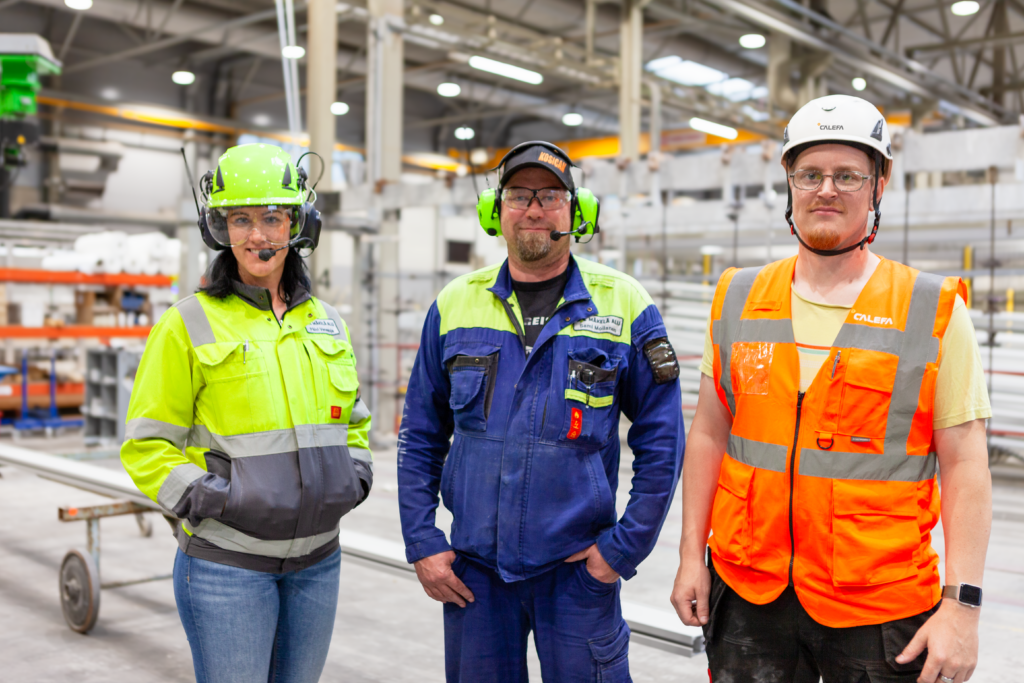
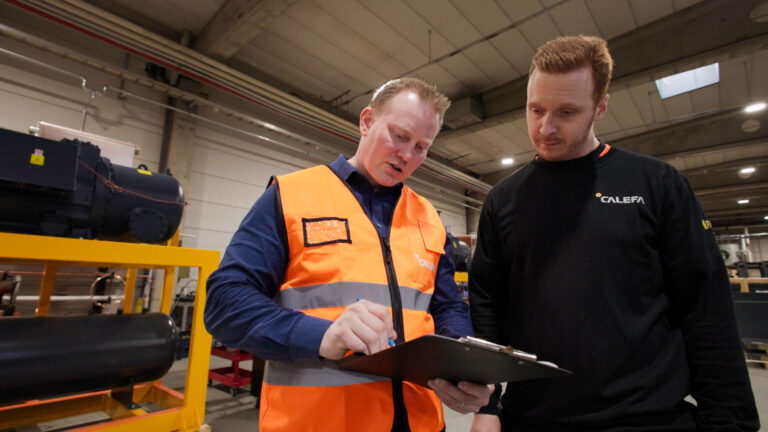
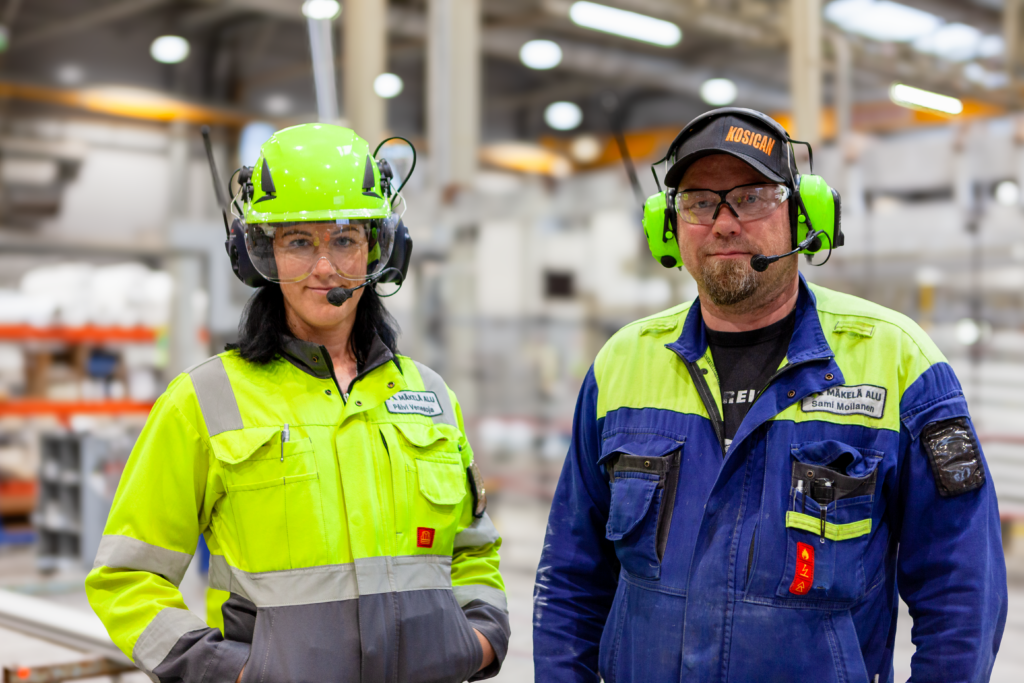
Partners in sustainability: together with Mäkelä Alu, Calefa has developed an optimally functioning energy system. From left to right: Mäkelä Alu’s Sustainability Director Päivi Venesoja, Process Operator Sami Moilanen, and Calefa’s Project Manager Joonas Palmi have been key players in this transformation.
Long before carbon neutrality became a global buzzword, Mäkelä Alu set an ambitious goal: to achieve carbon neutrality by 2025. This goal has now been achieved by improving energy efficiency, replacing fossil fuels with renewable energy and optimizing production processes. Calefa’s heat pump solutions have been an important part of this journey.
As part of this journey, the energy system of Mäkelä Alu’s anodizing plant has been systematically redesigned. The result is a factory with a carbon footprint reduced to a fraction of its former level.
Previously, the anodizing plant relied heavily on liquefied petroleum gas (LPG) using approximately 300 tons per year. The new system has completely phased out the use of liquefied petroleum gas making the anodizing plant’s energy system fully carbon neutral.
Generating heat through energy recycling
Calefa’s high-temperature heat pumps enable industrial processes to replace fossil fuels with renewable energy, delivering temperatures of approximately 120°C.
The renewed energy system of the anodizing plant is largely based on energy recycling. Waste heat generated at various points throughout the anodizing plant is recovered by a heat pump system, which upgrades the energy for use in anodizing processes, ventilation, and heating.
Over the years, additional sources of recoverable waste heat have been integrated into the system, and heat pump capacity has been expanded accordingly. The most recent upgrade was completed in summer 2023, doubling the plant’s heat pump capacity.
“Heat pumps and heat recovery play a major role in reducing emissions from surface treatment lines and heating. However, processes such as aluminum extrusion and foundry operations require temperatures over 400°C, which requires different types of solutions,” explains Tomi Pilbacka, Development Director at Mäkelä Alu.
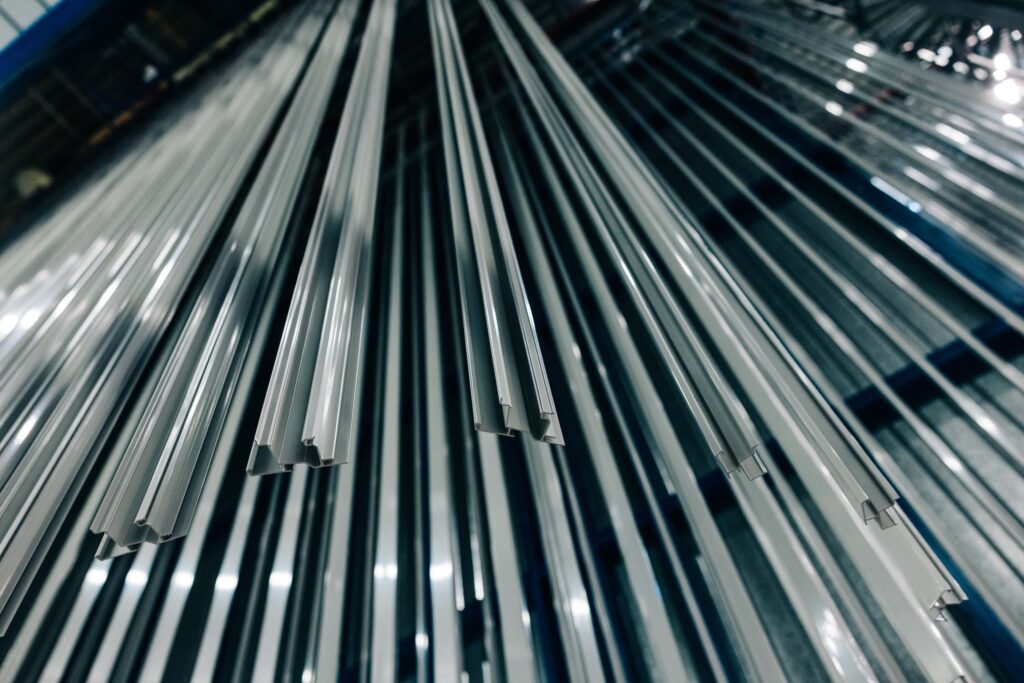
Through responsible operations and minimizing environmental impact, Mäkelä Alu supports the transition toward a more energy-efficient and greener future.
Efficient cooling and waste heat utilization
Improving energy efficiency and reducing emissions also create new opportunities to enhance production processes and working conditions, where temperature control plays a key role in both heating and cooling.
Mäkelä Alu began collaboration with Calefa in 2016 when the company invested in a new aluminum extrusion line designed for maximum energy efficiency and waste heat reuse.
Calefa implemented a hybrid module cooling and heat recovery system for Mäkelä Alu combining compressor cooling, free cooling, and heat pumps. The cooling of the press can utilize 1MW of thermal power for reuse while reducing CO₂ emissions and the need of purchased energy.
“Calefa’s involvement was a turning point enabling us to address key challenges and think on a much larger scale. For us, Calefa has been an essential partner in driving this development forward,” says Sami Moilanen, Process Operator at the anodizing plant.
Next, it was time to modernize the anodizing plant’s cooling and heating systems.
Previously, cooling relied on mains water and heating was provided by a steam plant with a high carbon footprint. These systems were replaced with a Calefa’s heat pump solution equipped with heat recovery, which is supplemented by an electric boiler when necessary.
The modern cooling system has significantly improved process technology. For example, by automating caustic cooling processes, the caustic no longer heats up whereas previously the line had to be stopped due to rising temperatures.
Improving the local exhaust with fan technology has enhanced indoor air quality and enabled a 40% reduction in ventilation power. In addition to saving energy, the upgrade eliminated negative pressure in the hall.
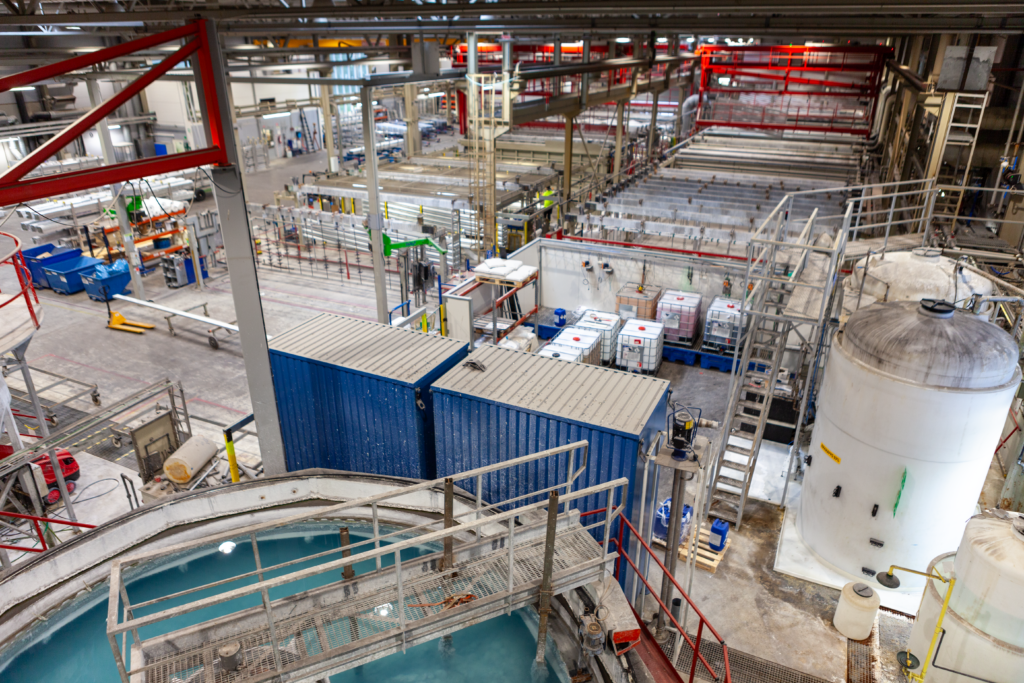
As part of the renewal of the anodizing plant’s energy system, the process technology has also been significantly improved. Thanks to efficient cooling, production downtime is now a thing of the past, and the indoor air quality in the production hall is good.
Long-term collaboration continues
The collaboration between Mäkelä Alu and Calefa is long-term and comprehensive. Most recently, Calefa has implemented a heat recovery solution at Mäkelä Alu’s aluminum foundry, capturing heat from casting cooling water to heat two nearby paint shops.
This system replaces LPG by using waste heat from the foundry’s cooling water to heat the paint shops’ pre-treatment processes.
“When it comes to energy efficiency, I believe this is an area where having a long-term partner is especially important. Constantly changing providers from one project to the next leads to partial optimization and weakens the overall outcome,” says Päivi Venesoja, Sustainability Director at Mäkelä Alu.
This kind of pioneering work requires a partner that can meet the company’s ambitious goals with both well-designed plans and concrete implementations. This, in turn, requires world-class expertise in energy efficiency, a deep understanding of industrial processes, and the ability to view the production facility and its surroundings as a whole.
Production facilities are complex systems in which all elements are interconnected. As processes evolve, the entire operation changes, and environmental performance must be continuously improved.
“We aim to find partners who are credible and whom we genuinely trust to deliver real results,” Pilbacka says.
Driven by responsibility, not just profit
Pilbacka notes that while these projects deliver energy and cost savings, Mäkelä Alu’s primary objective is to reduce emissions.
As part of their commitment to carbon neutrality, the company has invested approximately 10 percent of its annual turnover.
“That’s quite a significant commitment for a family-owned business and shows that we are serious about this. We want to do our part to ensure the sustainability of this planet and to combat climate change. This isn’t just about money for us, but also about future generations.”
Issues of responsibility and sustainability are becoming increasingly important in society, and companies are expected to take concrete action. For some customers, having the lowest possible emissions is a truly important criterion when choosing a product.
The family-owned company from Southern Ostrobothnia, Finland has taken a clear leadership role as a manufacturer of aluminum profiles, showing the way in how things should be done.
“I see Calefa as a reliable and knowledgeable partner. The fact that we can confidently move on to new projects as soon as the previous ones are completed reflects our satisfaction, and we are happy to continue the collaboration,” Pilbacka adds.